
Recording of EdD information session
Use this Passcode after clicking the button: 9Rx^8+ra
Graduate admission
The EdD in Educational Leadership and Policy provides advanced preparation for education practitioners with leadership and policy responsibilities in both formal and nonformal settings. These settings include, among many others, the post-secondary sector, business and health organizations, unions and community groups as well as the K–12 school system. The program is grounded in the belief that it is important for participants to engage in scholarly discourse about understanding, critiquing and improving practice in educational settings. It consists of six required seminars, two elective courses, a comprehensive examination and a dissertation.
While the program addresses Canadian educational issues and perspectives in a global context, it is the particular settings and leadership or policy responsibilities of the participants which is the starting point of seminars. The expertise of qualified adjunct faculty from related professional fields supplements that of the regular departmental faculty.
Style Of Instruction
-
- Two aspects of the EdD program affect the way its courses are designed and taught: the purpose of the program and the nature of its students. The purpose of the program is to engage students in the advanced study of educational leadership and policy in order that they can both critique and improve their own practice. It is this focus on practice—studying practice, trying to understand practice, being constructively critical of practice, improving one’s practice—that primarily distinguishes the program from more traditional doctoral programs whose aim is to prepare people for scholarship and the extension of knowledge.
-
- The students will be successful mid-career professionals who are actively (and, we assume, strenuously) engaged in the practice of educational leadership or policy decision making or both. Moreover, they will continue to be employed at these tasks while they are undertaking the program.
-
- It follows that classes need to be conducted in such a way that students can be thoughtful about practice and introspective about their own practice, and that the jobs the students hold can furnish ample material about “real” practice for this thoughtfulness and introspection to occur, and to occur, moreover, with high relevance to the participants’ own jobs and careers.
-
- Two assumptions seem warranted about the readiness of the EdD students to engage in critical reflection on practice: In their employment, such people have found themselves so frequently occupied with the need to deal with immediate issues, problems and crises that they have had little time for thinking about practice in general and their own practice in particular; they have had little time for what has been called “reflection” or introspection; they will welcome the opportunity through the program to develop ways of doing these things.
-
- These students can benefit from the enrichment of their conceptual resources which comes from being “reflective,” or introspective, about their own practice, and analytical about the concept of practice itself.
-
- These program features, corollaries and assumptions carry a number of implications for the way instructors should design and conduct courses. Instructors should recognize and respect the professional experience of the students. In matters of knowing at least one kind of practice, it may well be that the student is the expert and the instructor the novice.
Instructors need to be clear for themselves about what their own substantive expertise consists of, and they need to have thought carefully about its relevance to the interests and experience of the students.
- These program features, corollaries and assumptions carry a number of implications for the way instructors should design and conduct courses. Instructors should recognize and respect the professional experience of the students. In matters of knowing at least one kind of practice, it may well be that the student is the expert and the instructor the novice.
-
- The overall aims of each course need to be made clear at the outset, as do the reasons for these aims, for the students are likely to be people who are disinclined to put energy into an activity whose purpose they do not understand and subscribe to.
- The design of each class session should incorporate and critically examine both (i) participants’ experience and knowledge, and (ii) knowledge and conceptual structures generated by relevant academic study and research. Moreover, it should encourage active and critical reflection on the relationship of each to the other.
The instructor will act as facilitator as much as (or sometimes more than) teacher of substantive material.

What are the benefits of a cohort approach?
 What surprised you about the UBC EdD?
 Why choose the UBC EdD?
What is the importance of the annual EdD Institute?

How did the UBC EdD influence your practice?
Watch: Graduates and current students of the UBC Doctorate in Educational Leadership and Policy respond to questions frequently asked about the program.
Admissions Requirements for Graduate Study
All graduate program applicants in the Department of Educational Studies (EDST) must meet the minimum entry requirements established by the Faculty of Graduate Studies, which oversees graduate work at UBC. Applicants who do not meet the minimum requirements will be considered for admission only in exceptional circumstances.
General Eligibility
To be eligible for admission to an EdD program at UBC, applicants must hold a master's degree (or equivalent) from an approved institution with clear evidence of research ability or potential; or a bachelor’s degree with one year of study in a master's program with 12 credits of first class average, of which 9 credits must be at the 500-level or above and at least 9 credits must be of first class standing and clear evidence of research ability or potential. (For more detailed admissions requirements, please see the links below).
Graduate and Postdoctoral Studies - Minimum Academic Requirements: Canadian or U.S. Credentials
http://www.grad.ubc.ca/prospective-students/application-admission/minimum-academic-requirements-canadian-or-us-credentials
Graduate and Postdoctoral Studies - Minimum Academic Requirements: International Credentials
http://www.grad.ubc.ca/prospective-students/application-admission/minimum-academic-requirements-international-credentials
English Requirements
English Proficiency Test Score: Applicants whose degrees are from a university outside Canada in which English is not the primary language of instruction must present evidence of competency to pursue studies in the English language prior to being extended an offer of admission. Acceptable English language proficiency tests for applicants to graduate studies are:
- TOEFL (Test of English as a Foreign Language): Minimum score of 600 (paper version), 250 (computer version), 92 with a minimum of 22 in each component (iTB) is required for admission to all programs in Educational Studies. Visit TOEFL’s website
- IELTS (International English Language Testing Service): Minimum overall band score of 6.5 with no other component score less than 6.0.
- MELAB (Michigan English Language Assessment Battery): Minimum overall score of 81.
Tests must have been taken within the last 24 months at the time of submission of your application. The official test score must be sent directly from the test centre to Graduate and Postdoctoral Studies at UBC. Please follow the instructions on score submission on the Graduate and Postdoctoral Studies website: https://www.grad.ubc.ca/prospective-students/application-admission/english-language-test.
Questions and Answers About the EdD
Below are some questions that have been raised by those interested in the EdD program, along with our answers.
Q 1. I am between jobs. May I take the whole program as a full-time student and complete it in less than three years?
A 1. The program is designed primarily for people who are currently working and relies on the workplace as an important source of program content and as a site for carrying out the research project. Courses and other program requirements are scheduled in a manner that encourages reciprocation between the workplace and the program. This important feature of the program would be compromised if students did not have a place of work to apply learning. We are always very prepared, however, to discuss individual circumstances which depart from the norm.
Q 2. I can get a one-year leave from my job in order to start the EdD program. Can I begin the program full time and finish it while working?
A 2. Yes, provided that you maintain links with your workplace during your leave so that coursework can be related to your practice. During the year of your leave you will be encouraged to complete all the elective courses in your program. These courses will be identified in consultation with the Cohort Advisory Committee the members of which will help you determine appropriate courses.
Q 3. I would like to get started on coursework before the program begins. Can I take courses now as an unclassified student and then have them recognized in the EdD program when I am admitted?
A 3. No. Current university policies discourage students from taking courses prior to beginning a graduate program that they wish to have applied to that program. Special sections of required courses are offered for students in the EdD program, so even though these courses may be offered at other times, it is important to take required courses with other members of your cohort.
Q 4. I can get a one-year leave from work for the second or third year of my program. Can I begin the program while working and finish it as a full time student?
A 4. Yes, but remember that maintaining links with your workplace is an essential element of this program, especially in completing the research project. A leave during the second year of the program would allow you to complete your elective courses during that year and to focus your energy on the development of the project proposal. You may even be able to make substantial progress on the project before returning to work. A leave during the third year of the program would allow you to devote your full attention to the research project, but remember that it will be necessary to maintain links with your workplace in order to complete it.
Q 5. What if I become pregnant or ill during the program and cannot continue with my cohort. Do I have to drop out of the program?
A 5. No. Students do encounter a wide range of circumstance that may prevent them from completing the program with their cohort. Assuming that this happened during the first two years of the program, you would apply for a one-year leave from the program, paying the current on-leave fee listed in the University Calendar. On your return to study, you could take elective courses or work on the development of your research proposal until you were able to join the next cohort. The university’s on-leave regulations for graduate students apply to all students in the EdD program.
Q 6. I am interested in the program but cannot begin for two years. Can I apply now if I want to start the program in two years?
A 6. No. You should apply for admission to the program in the year preceding the year you wish to begin the program.
Q 7. My CEO is interested in my doctoral project, has a doctorate herself, and would like to supervise my project. Can this be done?
A 7. It makes sense to have your CEO involved with the project because it will be related to your workplace, but the supervisor of the doctoral project must be someone who has a UBC faculty appointment and is approved for doctoral student supervision. Qualified senior practitioners—like your CEO—may serve as members of EdD research supervisory committees with the approval of the Dean, Faculty of Graduate Studies.
Q 8. Family/work commitments make it very difficult for me to attend both of the six-week summer sessions. Can I take 3 credits during each summer and pick up an additional three credits in each Winter Session?
A 8. No. We consider the two six-week summer sessions to be very important for developing and maintaining relationships within the cohort, for meeting potential committee members, for participating in various seminars and social events, and for using library and other university resources. Even if you live and work in the Vancouver area, we consider it very important that you arrange your work and family obligations so that you can participate as fully as possible during the summers.
Q 9. Why is tuition for the EdD program so much higher than for the PhD program?
A 9. The EdD is a market-priced professional program which means that tuition is based, in part, on what is charged by similar doctoral-level programs designed for practicing professional educators. The effect of this is that tuition covers a higher proportion of actual program costs than is the case with the PhD program, which is subsidized to a much greater extent than is the EdD.
Q 10. The program description says that applicants must be employed in leadership positions in education. I’m not sure if I qualify. What exactly do you mean by leadership positions in education?
A 10. This program is designed for experienced professional educators who are regarded as key members of the organizations for which they work. It is not possible to list all the “positions” that would qualify someone for the program, nor is it possible to list all the types of organizations in which people are engaged in the design, delivery and administration of educational activities. Following, though, are some examples of the kinds of positions and settings that we had in mind as we developed this program:
- School principals and superintendents.
- Leaders in professional associations and societies.
- College and university deans and department heads.
- Program directors in schools and continuing education divisions.
- Directors of staff development, human resource development or training.
- “Middle managers” with primary responsibility for education or training.
- Classroom educators with policy or leadership responsibilities.
- Experienced educational consultants working in private or public sector organizations.
EdD Leadership Awards
A small number of EdD Leadership Awards are available annually for students in each EdD cohort. The value of these awards ranges may vary but is usually $3,000 each.. Awards are applied to the student’s tuition account. The purpose of these awards is to recognize the academic and professional accomplishments of students in the program and to ease the financial burden of participating in the program for those who are less financially secure.
All those admitted to the program will receive application forms and instructions for the EdD Leadership Awards.
Criteria
Priority will be given to applicants
- whose most recent graduate work reflects a high level of academic achievement;
- whose recent professional accomplishments reflect a high level of commitment to the improvement of educational practice;
- who are fully responsible for funding their studies (that is, not receiving financial support for their studies from employers, granting agencies, or other non-repayable sources);
- whose circumstances are such that participation in the program represents a significant financial burden;
- who are entering the first, second or third year of the EdD program. Awards are not made to applicants who will be on leaves of absence from the program during the year they are applying for the award.
Procedure
New and continuing students who wish to be considered for an EdD Award should complete an application form and provide all supporting materials to the EdD Program Secretary, Department of Educational Studies, by May 31st. Application forms should be accompanied by a transcript of all graduate work completed and a statement (two pages maximum) that addresses each of the above criteria.
Program Requirements
Ed.D Program completion requirements include 6 Required Courses (listed below), 2 Electives, a Comprehensive Exam, and a Thesis Defense.
Program Worksheets are available here: https://edst.educ.ubc.ca/resources/forms/
Program Schedule
| YEAR 1 | EDST 601 | EDST 593 | EDST 603 | |
| EDST 577 | ||||
| Jul – Aug | Sep – Dec | Jan – Apr | ||
| YEAR 2 | EDST 604 | Elective | EDST 602 | Comprehensive Exam |
| Elective | ||||
| Jul – Aug | Sept – Dec | Jan – Apr | Apr – Jun | |
| Research / Dissertation Phase | Research Proposal |
Research | Write Thesis |
Thesis Defense |
| Time frame dependent upon research/dissertation proposed | ||||
Required seminars and elective courses are typically 3 credits each. The schedule of required and elective courses for the cohort beginning in July, is as follows:
Summer (July – August) - First Year
First Year Doctoral Seminar (EDST 601). This seminar begins the cohort’s exploration and critique of their own practice in the light of issues, problems and concepts which will be important throughout the program—including education, leadership, ethics, policy, and practice—and the relationships among them.
Ethics in Educational Leadership EDST 593A (971). This seminar focuses on understanding and addressing ethical problems drawn from the students’ own practice. Ethical theories and forms of ethical analysis are applied to these problems to develop morally defensible responses.
Term 1, Winter (September – December) - First Year
The Social Context of Educational Policy (EDST 577). This seminar explores the nature of educational policy in relation to its social context. It includes policy issues drawn from the students’ own worlds of practice.
Term 2, Winter (January - April) - First Year
Researching Educational Practice and Policy (EDST 603). This seminar focuses on what it means to conduct research in and on educational practice. Research paradigms, epistemological debates and their methodological implications are discussed. A variety of completed EdD research projects are analyzed.
Summer, (July–August) - Second Year
Advanced Seminar in Researching Educational Practice and Policy (EDST 604). The purpose of this seminar is to help students develop the methodological expertise needed to carry out their research projects. Students will learn how to select and apply various research tools and techniques commonly used in the study of educational practice.
Elective # 1. Selected by students in consultation with the Cohort Advisory Committee.
Term 1, Winter (September to December) - Second Year
Elective # 2. Selected by students in consultation with the Cohort Advisory Committee.
Term 2, Winter (January - April) – Second Year
Doctoral Seminar (EDST 602). This final seminar focuses on reviewing and integrating concepts that are central to the program and relating these understandings to practice in preparation for the comprehensive examination and thesis research.
- A comprehensive examination is required following the 2022 Winter Session.
- During each summer session, students meet with a Cohort Advisory Committee the members of which respond to questions, offer advice about elective courses, suggest other faculty whom students should meet to discuss research ideas and help with other issues related to the program. Once a student decides the focus of his or her research, a Research Supervisory Committee is formed which then takes responsibility for supervising the student through to program completion.
- The EdD dissertation is the report of a research project in which the student has intensively studied a problem or set of circumstances in his or her practice. The research is developed under the supervision of a committee which may include (with approval) a senior and appropriately qualified practitioner from a relevant area of education. One part of the dissertation may take the form of a document (or its equivalent in a non-print medium) of the kind commonly used in the field, such as a policy handbook or policy document, an action plan, a white paper, a curriculum or project design, a program evaluation, an institutional reorganization, a community development prospectus, or any other relevant innovative undertaking. If this is the case, the candidate must also provide, as part of the dissertation, documentation sufficient to allow others to follow the line of reasoning and evaluate the originality, usefulness, and credibility of the work.
Evaluation of the dissertation will be based on both academic and professional norms. The former include, for example, the coherence and integrity of the argument, the adequacy of the research base, the quality of the analysis, and interpretation of relevant conceptual and theoretical work. The latter include the educational impact of the work, the level of insight and imagination applied to the issues being dealt with, the sensitivity to historical and local circumstances, and the feasibility and requisite support for recommendations.
All EdD students prepare a dissertation research proposal, the format and substance of which is established in consultation with the student’s Research Supervisory Committee. The proposal is developed as early in the student’s program as possible, but no later than the end of the second year.
- Coursework and other requirements are scheduled so that students can complete the program in three years from initial registration. It should be noted, however, that most students may take longer than this. A student who, by reason of illness or altered personal circumstances, is granted leave from the program and is therefore unable to proceed with his or her cohort, will be able to complete required courses with the following cohort.
ED.D. COMPREHENSIVE EXAMINATION GUIDELINES
Purpose
The Ed.D. in Educational Leadership and Policy is centrally concerned with educational practice. It assumes that students and faculty will contribute broad knowledge from diverse backgrounds to scholarly dialogue about theory, practice and the complex interrelationship between the two. Special attention is given to the program’s five key topics: education, leadership, ethics, research, and policy as embodied in the “Five Fundamental Questions”: (1) What is education? (2) What is an educational practice? (3) How might we judge ‘improvements’ of educational practice? (4) How can we study educational practice? (5) How has what we have studied impacted our ability to critique and improve our own practice? While some courses emphasize particular topics at various times during the program, the entire program—including the thesis--is meant to be an integrated dialogue between practice and scholarship. The comprehensive examination is intended as an opportunity for students to begin to develop a framework for their dissertation and present this in writing and publicly.
Instructions
Students are expected to complete the examination requirements between the conclusion of EDST 602 and the end of the second year of the program. The examination assumes that the required courses in the program have been completed and entails both written and oral aspects.
The Written Framework
The framework involves (1) identifying an educational problem from your practice that leads to your initial research question or questions and (2) beginning to develop a significant aspect of your proposed research. Maximum length is 7500 words.
(1) Explain and document the educational concern from your practice that impels your proposed research. Some possible considerations include: Why is this problem a concern? Why is it an educational concern? How did it develop? What are some of the contributing factors and implications? What aspects of this problem do you plan to study and what research question(s) follow? How will your research begin to address this problem?
(2) Given your understanding of the educational problem at issue, conduct a critical analysis of a body of scholarship relevant to your proposed doctoral research. Choose one of two options:
- Review the current state of the scholarly research on the problem and identify specific areas that you will address in your study.
- Select and justify the conceptual and theoretical framework that underlies your understanding of the problem and your proposed research.
The Oral Examination
The oral part of the examination involves both outlining the framework and responding to questions from the Examination Committee and other interested parties. Total time allocated for the presentation section is 20 minutes; the entire examination will last approximately one hour.
Criteria for Evaluating the Framework
The Framework will not be evaluated for comprehensiveness, but will be assessed by how well it:
- integrates practical experiences, what has been learned in the courses and in the scholarly review for the Framework;
- is organized around and related directly to the thesis you are developing;
- synthesizes results into a summary of what is and is not known;
- identifies areas of controversy in the existing scholarship and practices;
- formulates questions that need further research;
- presents arguments that are logical, coherent and are supported by appropriate evidence and examples;
- accurately reflects the relevant conceptual and theoretical resources;
- shows that you are critically reflective bringing your own interpretation and not just repeating what others have said;
- is written in clear, concise and compelling prose.
Criteria for Evaluating the Oral Presentation
The oral presentation should provide a brief cohesive account of the framework and the process of developing it in a manner consistent with the intended audience. Answers to questions will be judged by the norms of both scholarship and the student’s professional practice.
The Follow-up
You will be notified of the results of the adjudication within two weeks. In the event that the Examination Committee asks for revisions or clarifications you will be given a maximum of 6 weeks to complete minor amendments and up to four months for more extensive revisions.
The structural features of the program are as follows:
Students are admitted in groups of 10–12 and proceed through the program as a cohort. It is possible to complete program requirements in three years although most students take longer, depending upon the research/dissertation proposed and undertaken. The first cohort began the program in July 1997 and the eighteenth cohort commenced in July 2023. Please see application deadlines for information on the due date for applications for this cohort.
Required coursework is offered in seminars that take into account the continuing professional responsibilities of those educators the program is designed to attract. Seminars during the Summer Session are scheduled on campus in six-week blocks during July and August. Winter Session runs from September to April and is divided in two terms. Term 1 is from September to December and Term 2 from January to April. Winter Session seminars normally meet four times each term on Fridays from 5 to 9 p.m. and Saturdays from 8:30 a.m. to 4:30 p.m.
Each cohort attends classes on campus for two consecutive Summer Sessions (July to mid-August) and two consecutive Winter Sessions (September to early April). Coursework consists of 18 credits of required seminars and 6 credits of elective courses, chosen in consultation with a cohort advisory committee to either broaden the student’s academic background or to contribute directly to the development of the proposal for his or her research project. During the Winter Session, a limited number of elective courses may be available in the weekend-only format described above. Students who are able to attend more conventionally scheduled courses on campus will have a broader selection of electives and are encouraged to consider courses anywhere in the university that are relevant to their professional responsibilities. With prior approval, electives may also be taken at other universities or completed via directed studies and the Web.
| The difference this program made for me |
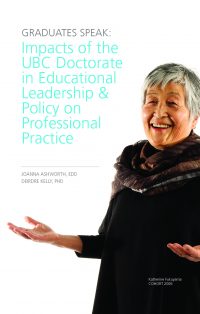 |
| Graduates Speak: Impacts of the UBC Doctorate in Educational Leadership & Policy on Professional Practice |
| EdD Alumni |
Apply Online: https://www.grad.ubc.ca/prospective-students/application-admission
The number of graduate students who can be accommodated in the EdD program is limited and only the most qualified applicants will be accepted. To ensure that all applicants are treated equitably, your application will go through several stages before a decision is made on acceptance or rejection. Once your transcripts have been reviewed to determine if you are eligible for admission to graduate study at UBC, the EdD admissions committee will review your application and assess your suitability for admission to the program.
As well as evaluating all components of your application, the Admissions Committee must be convinced by the statement of intent that your academic interests are congruent with those of the EdD program, and that your background is adequate for doctoral level work in the program.
Applications should be submitted online at https://www.grad.ubc.ca/prospective-students/application-admission. All of the following components of an application must be received by the department’s Graduate Program Assistant before the file can be reviewed by the appropriate admissions committee.
a. Online UBC application form. When you submit an online application at https://www.grad.ubc.ca/prospective-students/application-admission, the completed form is automatically forwarded to the Graduate Program Assistant. Non-refundable processing fee payable to UBC. See the cover of the official UBC application form for the exact amount.
b. Upload digital copies (.pdfs) of official transcripts. See Digital Copies of Official Transcripts tabfor details.
c.
Three references – The purpose of the references is to give as complete an idea as possible of your relevant background and capacity to complete the degree. Two of the references should be from a course instructor or other person able to assess your academic ability. Other suitable referees include a supervisor, president, academic dean, or another person to whom you are, or have been, accountable in employment or as a volunteer. The reference letters must be in English. If the original letter is in another language, the letter must be accompanied by a certified English translation. There are three possible formats for references:
- Electronic references: In the online application system, applicants are asked to provide an email address for each referee. Once the online application has been submitted, a unique link will be emailed to each referee, allowing them to log in to a secure site and submit an online reference or upload a reference document as an attachment.
- Letters of reference: Your referee may wish to send a paper letter. Paper letters of reference should be on referee’s official letterhead and signed. It must be mailed directly by the referee to the EDST Program Office to the following address in a sealed and endorsed envelope.
EDST Program Assistant
Department of Educational Studies, Faculty of Education
Ponderosa Commons North (Oak House)
2005 - 6445 University Boulevard
Vancouver, British Columbia, Canada
V6T 1Z2 -
Reference forms: UBC provides a general reference form. Your referee may fill out this form and mail it directly to the EDST Program Office in a sealed and endorsed envelope.
Notes:
- All references must be sent by referees directly. Reference letters or forms submitted by the applicant will not be accepted.
- The application system and department are unable to accept referee emails from Hotmail, Yahoo, Gmail, MSN or other free email accounts.
- By “sealed, endorsed envelope” we mean that the envelope needs to be sealed and that the signature of the referee be placed over the seal (i.e., partially on the flap and partially on the rest of the envelope).
d. Letter of intent. This statement should relate your academic background, work experience and career goals to the program. You must describe in one to two pages your specific reasons for pursuing the EdD in Educational Leadership and Policy. This statement should highlight:
- why you are applying to the EdD program
- information on your background and experience in educational leadership and policy (both employment and volunteer work). how you see your life experience contributing to the program
- what you hope to gain from the program
e. Writing sample. Please submit your thesis or graduating paper if one was required in your masters program. In addition, please submit a professional publication, policy document, or other work that demonstrates your writing talents. The sample should demonstrate your ability to think clearly about complex issues and to communicate in an organized and readable manner. Submissions will be returned on request.
f. Submit an up-to-date professional resumé or curriculum vitae, directly to the Graduate Program Assistant as part of the application package.
After submitting your application, it is the applicant’s responsibility to ensure that all supporting materials are submitted by the application deadline. The Admissions Committee will only review completed applications. You can check the status of your application and supporting materials through the online application system.
Applicants from outside Canada should be aware of additional requirements that may apply. Please read the following to determine which of these requirements may apply to you.
International Credentials Equivalency
Please see the Office of Graduate and Postdoctoral Studies website:
http://www.grad.ubc.ca/prospective-students/application-admission/minimum-academic-requirements-international-credentials
International Transcripts and Translation Requirements
See International Transcripts and Translation Requirements tab for detail
Entering Canada
To enter Canada, a “Student Authorization” (Student Visa) is required. Apply as soon as possible to the nearest Canadian Consular or Immigration Office since it may take 8–10 weeks for processing. For applicants applying from the People’s Republic of China it may take 3–6 months. Applying for a Student Authorization requires a UBC letter of admission/acceptance; a valid passport; and evidence of adequate funds for tuition, maintenance of the student and, if married, the student’s spouse and children, plus travel funds to and from Canada. Please consult the Immigration Canada website: http://www.cic.gc.ca/english/index.asp.
If the application for a visa is approved, the UBC letter of admission/acceptance will be returned to the student and must be retained for presentation to the Immigration Officer at the Canadian point of entry.
Canadian Transcripts
UBC has changed its application document requirements.
If you are applying to begin study in 2016 or beyond, you will normally scan and upload digital copies (.pdfs) of official required documents in the application system. These are considered "unofficial documents". These uploaded copies of your official documents will be used for initial evaluation of the applicant.
Conditional admission offers may be made based on documents uploaded to the application system. However, admission offers will not be finalized and applicants will not be allowed to register in a graduate program until one set of all required official academic records are received and validated by the University.
UPLOADING UNOFFICIAL COPIES OF TRANSCRIPTS IN THE APPLICATION SYSTEM
Applicants with Canadian transcripts (other than UBC) must obtain an official paper transcript for every post-secondary institution they have attended. UBC transcripts are not required.
Each transcript should be scanned as an individual .pdf file and then uploaded to the application system as indicated. They should be named: "Applicant Full Name-Document Description.extension"
Examples:
Kelly Smith-University of Waterloo Transcript.pdf
Kelly Smith-CV.pdf
Kelly Smith-Journal of Neurosciences Paper.pdf
Transcripts must be scanned front and back. All pages of one transcript, front and back, should be uploaded as a single file (rather than a separate file for each page).
OFFICIAL TRANSCRIPTS
To be considered official, academic records must either be received in official university envelopes, sealed and endorsed by the issuing institution, or be sent via secure electronic delivery by the issuing institution.
If you have been offered admission conditional upon receipt of official documentation, you must provide UBC with one set of official transcripts for every postsecondary institution you have attended for the equivalent of one year or more of full-time study. UBC reserves the right to also require any individual applicant to provide official transcripts for study of less than one year duration. Do not send official transcripts before receiving an offer of admission unless you have received special instructions from the graduate program to which you have applied.
Documents being provided to meet conditions of admission should be sent directly to:
Graduate & Postdoctoral Studies
University of British Columbia
6371 Crescent Rd
Vancouver, BC CANADA V6T 1Z2
CURRENT AND FORMER UBC STUDENTS
You do not need to submit UBC transcripts as part of your graduate application, as this data is already available through the student database system. However, be aware that you are still responsible for submitting transcripts from all other post-secondary institutions that you have attended (e.g., exchange year, transfer year, etc.).
International Transcripts and Translations
UBC has changed its application document requirements.
If you are applying to begin study in 2016 or beyond, you will normally scan and upload digital copies (.pdfs) of official required documents in the application system. These are considered "unofficial documents". These uploaded copies of your official documents will be used for initial evaluation of the applicant.
Conditional admission offers may be made based on documents uploaded to the application system. However, admission offers will not be finalized and applicants will not be allowed to register in a graduate program until one set of all required official academic records are received and validated by the University.
UPLOADING UNOFFICIAL COPIES OF REQUIRED DOCUMENTS IN THE APPLICATION SYSTEM
Applicants with transcripts from non-Canadian post-secondary institutions must obtain an official paper transcript for every post-secondary institution they have attended.
Each transcripts should be scanned as an individual .pdf file and then uploaded to the application system as indicated. Otherwise, they should be named: "Applicant Full Name-Document Description.extension"
Examples:
Peng Zhang-Peking University Transcript.pdf
Peng Zhang-Peking University Transcript English Translation.pdf
Peng Zhang-CV.pdf
Peng Zhang-Journal of Neurosciences Paper.pdf
Transcripts must be scanned front and back. All pages of one transcript, front and back, should be uploaded as a single file (rather than a separate file for each page).
If you have transcripts that are issued in a language other than English, then in addition to uploading digital copies of the documents in their original language, you must also upload a certified literal English translation of your transcripts from your home university's translation service or certified English translator.
Please consult the document scanning and uploading instructions provided within the online application for detailed instructions.
OFFICIAL DOCUMENTS
To be considered official, academic records must either be received in official university envelopes, sealed and endorsed by the issuing institution, or be sent via secure electronic delivery by the issuing institution.
After being offered admission: If you have been offered admission conditional upon receipt of official documentation, you must provide UBC with one set of official transcripts for every postsecondary institution you have attended for the equivalent of one year or more of full-time study. UBC reserves the right to also require any individual applicant to provide official transcripts for study of less than one year duration.
If an official transcript does not indicate the degree name and the degree conferral date, then an official copy of the degree certificate must also be submitted
If your university issues only one original copy of transcripts/degree certificates:
Make photocopies of your original academic records and send them to your home university. Ask your home university to:
- verify that the photocopies are consistent with their records.
- attest that the copies are true photocopies and stamp them with an official university stamp.
- put the attested, stamped photocopies in sealed envelopes endorsed by the Registrar.
- mail the sealed, endorsed envelopes directly to Graduate & Postdoctoral Studies.
If your transcripts are issued in a language other than English:
- arrange to have a set of all official transcripts issued in their original language.
- obtain a certified literal English translation of your transcripts from your home university's translation service.
- send both the original transcripts and the literal English translation to UBC Graduate & Postdoctoral Studies.
If your home university does not provide English translations of transcripts:
- make a photocopy of your copy of your transcripts. Do not open a sealed, endorsed envelope containing transcripts intended for submission to your program.
- take the copy to a certified English translator and ask them to provide a complete, word-by-word, literal English translation.
- tell the translator to put both the original language photocopy and the English translation into a sealed envelope, and endorse the envelope by signing across the seal.
- send the sealed, endorsed envelopes from the translator to UBC Graduate & Postdoctoral Studies.
- send your original transcripts in the original language to UBC Graduate & Postdoctoral Studies.
Note: Academic records must be translated in their entirety, including any information that appears on the reverse side of any document.
UBC does not accept the following:
- photocopies that have not been stamped, attested and endorsed by the Registrar at your home university
- documents in envelopes that have been opened
- documents that do not arrive in sealed envelopes endorsed by the issuing institution or certified translator
- documents that arrive without the official seal of the university
- photocopies notarized by a notary public
- photocopies endorsed by a lawyer, professor, judge etc.
- unofficial translations
- non-literal translations
Do not send academic records that are not in sealed and endorsed envelopes. It will only delay the processing of your application.
Documents being provided to meet conditions of admission should be sent directly to:
Graduate & Postdoctoral Studies
University of British Columbia
6371 Crescent Rd
Vancouver, BC CANADA V6T 1Z2
Note that fees are subject to change by the University.
Tuition for PhD and EdD Programs
Tuition fees for PhD and EdD Programs are found on the UBC Calendar website.
Deadlines for applications
Deadlines for the EDST EdD program can be found on the EDST website.
Critical Voices
In acknowledgement of the nature and purpose of the EdD program, editions of the online publication Critical Voice will be constituted by submissions, from the program’s current students, alumni and faculty that:
- Focus on practice-studying practice, trying to understand practice, being constructively critical of practice, improving one’s practice
- Provoke scholarly engagement, through the critical examination of professional practice
- Highlight (acknowledge/celebrate) the relationship of professional experience and reflexivity, as informed through academic study and research
The problematic of educational policies is the theme of the first issue of Critical Voices. An invitation was distributed to all EdD cohorts on March 25, 2025, outlining the main criteria required for submissions.
Submission:
Please send your submissions to Dana Goedbloed, Editor in Chief at goedworks@gmail.com
Contact Us
Quick links:
| Deadlines | Eligibility | English requirements |
| Housing | How to Apply | FAQ - Prospective Students |
| Tuition |
For more information about this program, the department and admission procedures can be found at https://www.edst.educ.ubc.ca or by contacting:
EDST Graduate Program Assistant
or
Dr. Tony Edwards, Academic Coordinator
Email: anthony.edwards@ubc.ca
or